4F Custom RGP – Cantor Barnard
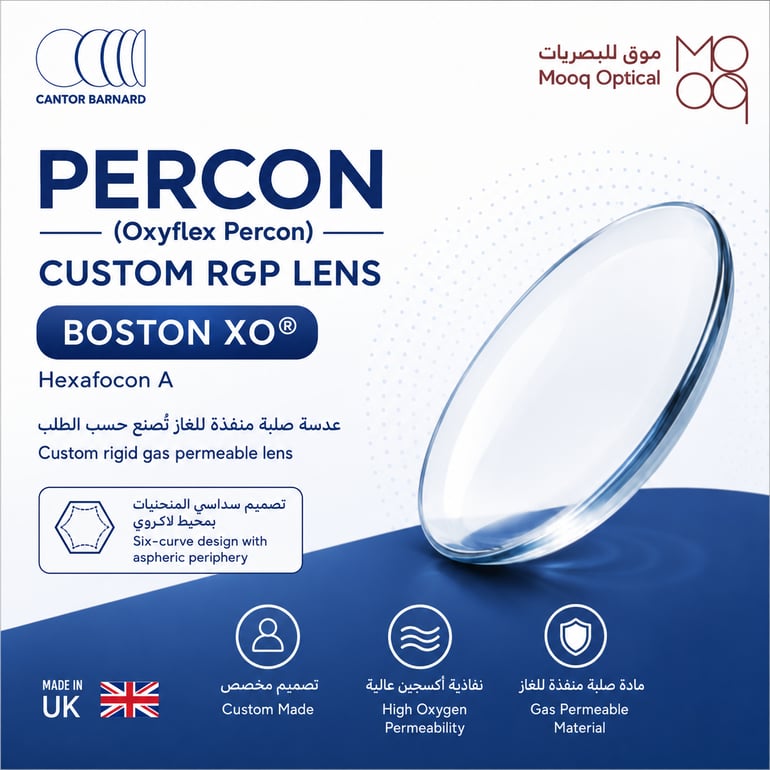
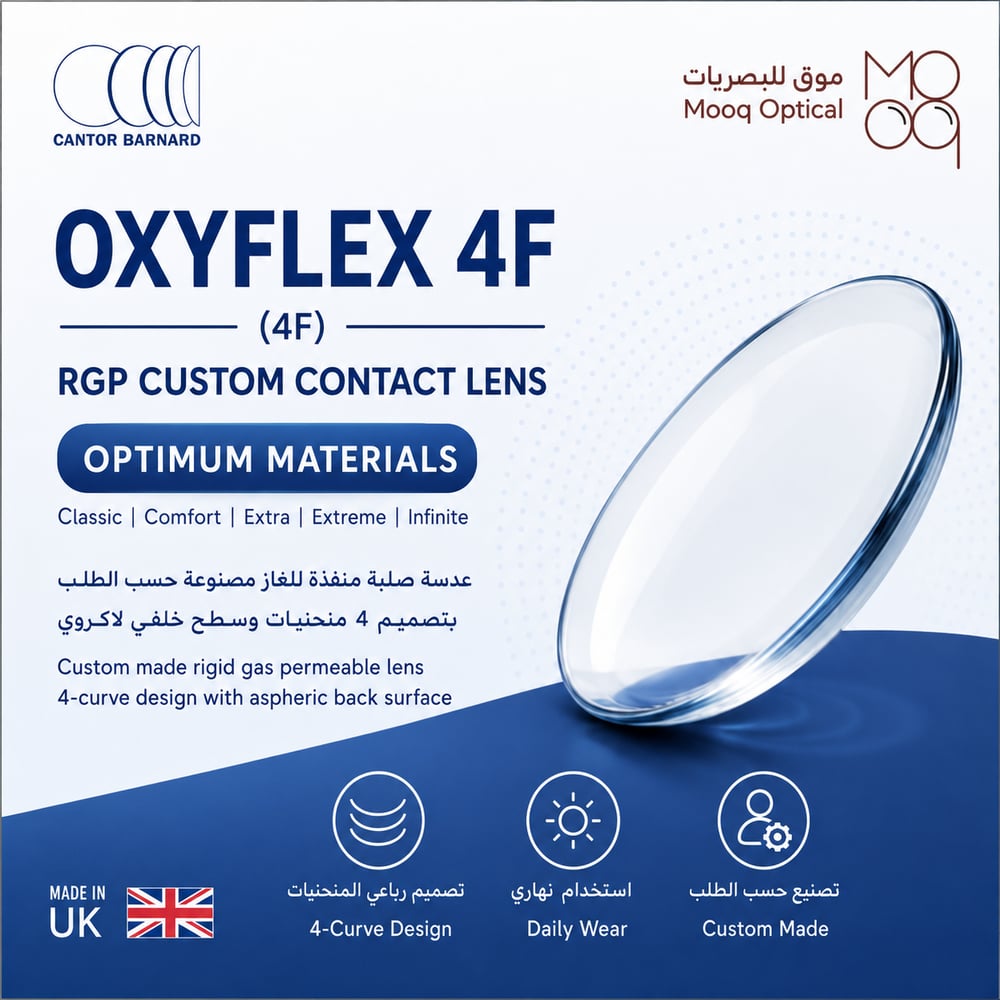
4F Custom RGP by Cantor Barnard is a custom-made rigid gas permeable contact lens manufactured according to the corneal measurements and prescription of each eye.
The design combines a:
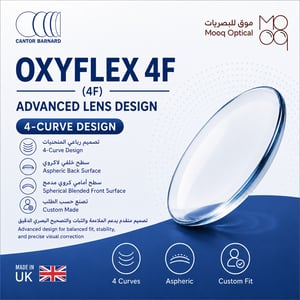
4-Curve Design
with an:
Aspheric Back Surface / Periphery
providing a smooth transition from the central optical zone toward the lens periphery and supporting an appropriate fit when the correct parameters are selected by an eye care professional.
Cantor Barnard classifies 4F as a high-quality custom RGP lens intended for:
Daily Wear
Delivery Time
The lenses are supplied within a maximum period of:
30 to 60 days
from the date the order is confirmed.
Custom Optical Design
The 4F design offers an officially published power range of:
-30.00D to +30.00D
and can be manufactured in several different RGP materials.
This allows the eye care professional to select the most appropriate material according to:
- Oxygen permeability requirements
- Lens stability
- Wettability
- Prescription
- Lens design
- Wearing requirements
Current material options include:
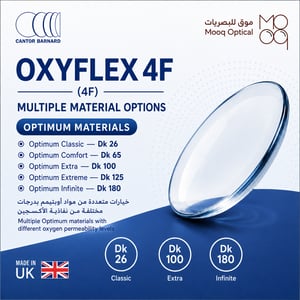
- Optimum Classic
- Optimum Comfort
- Optimum Extra
- Optimum Extreme
- Optimum Infinite
The lens is not supplied as a standard one-size-fits-all product.
The following parameters must be professionally determined:
- Base Curve
- Diameter
- Power
- Material
- Any required Toric modifications
For a product page, it is most appropriately presented as:
Custom Made / Made to Order
with prescription review by an eye care professional before manufacturing.
Key Features
- 4-Curve Design
- Aspheric Periphery
- Custom-made according to the measurements and prescription of each eye
- Published power range from -30.00D to +30.00D
- Multiple Optimum material options
- Different oxygen permeability levels
- Specialized Toric options
- Daily Wear
- Stable RGP optical performance
- Professionally fitted
- Manufactured in the United Kingdom
Suitable Applications
The 4F lens is primarily intended to correct refractive errors using a customized corneal RGP lens.
Suitable corrections include:
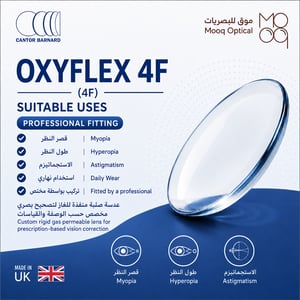
- Myopia
- Hyperopia
- Astigmatism
It may be particularly useful when the patient requires:
- Custom Base Curves
- Custom Diameters
- Higher or unusual powers
- Parameters unavailable in standard stock lenses
- Specialized Toric modifications
4F should not primarily be presented as a dedicated Keratoconus lens.
Cantor Barnard offers other designs specifically intended for irregular corneas and Keratoconus, including Nissel KII.
Basic Product Information
Property | Specification |
|---|
Design Name | 4F |
Historical Name | Oxyflex 4F |
Manufacturer | Cantor Barnard |
Country of Manufacture | United Kingdom |
Category | Rigid Gas Permeable – RGP |
Lens Type | Custom Made |
Wear Schedule | Daily Wear |
Number of Curves | 4 Curves |
Back Surface | Aspheric |
Front Surface | Spherical Blended |
Primary Uses | Myopia / Hyperopia / Astigmatism |
Maximum Replacement Period | 12 Months |
Fitting | By an eye care professional |
4F Design Concept
The principal feature of the design is the combination of:
Four Curves
with an:
Aspheric Back Surface
The objective is to provide a smooth peripheral transition and a balanced relationship between the lens and cornea.
Historical Oxyflex 4F literature describes the design as aiming to provide:
Balanced Periphery
with:
Optimum Edge Lift
across the fitting range.
The current version is described as:
4-Curve with Aspheric Periphery
Design Specifications
Element | Design |
|---|
Back Surface | Aspheric |
Front Surface | Spherical Blended |
Peripheral System | 4-Curve |
Fitting Type | Corneal RGP |
Manufacturing | Lathe-Cut Custom Made |
Current Base Curve Range
The current official booklet lists the following Base Curves:
7.05 – 7.12 – 7.20 – 7.27 – 7.35 – 7.42 – 7.50 – 7.57 – 7.65 – 7.72 – 7.80 – 7.87 – 7.95 – 8.02 – 8.10 – 8.17 – 8.25 – 8.32 – 8.40 – 8.47 mm
Additional values may be available on request.
Diameter
Current published range:
8.60–10.60 mm
in:
0.10 mm steps
Older literature listed specific Diameters such as:
8.60 / 9.00 / 9.40 / 9.80 / 10.20 / 10.60 mm
For a current product listing, the published range of:
8.60–10.60 mm in 0.10 mm steps
is the more appropriate reference.
Power Range
Current published range:
-30.00D to +30.00D
Power steps:
0.25D
Higher powers:
May be available on request
Older 4F literature included ranges up to approximately:
±40.00D
but this should not be presented as a standard current option unless confirmed by Cantor Barnard for the specific order.
Current Material Options
The current January 2026 booklet lists five Optimum materials:
Material | USAN / Scientific Name | Dk |
|---|
Optimum Classic | Roflufocon A | 26 |
Optimum Comfort | Roflufocon C | 65 |
Optimum Extra | Roflufocon D | 100 |
Optimum Extreme | Roflufocon E | 125 |
Optimum Infinite | Tisilfocon A | 180 |
These materials provide a broad range of oxygen permeability values.
Optimum Classic
Dk 26
A relatively lower-Dk material primarily suited to conventional daily-wear corneal GP lenses.
Optimum Comfort
Dk 65
A mid-Dk option appropriate for daily-wear corneal lenses.
Optimum Extra
Dk 100
Provides higher oxygen permeability together with good wettability.
Optimum Extreme
Dk 125
A high oxygen-permeability material suitable for a broad range of GP designs.
Optimum Infinite
Dk 180
A Hyper-Dk material offering very high oxygen permeability together with good resistance to flexure and scratching.
Material selection should be made by the eye care professional according to:
- Lens thickness
- Corneal oxygen requirements
- Wearing hours
- Prescription
- Lens design
- Clinical needs
Handling Tints
Cantor Barnard lists:
Actual tint availability depends on the material selected.
Recommended wording:
Handling Tint: According to color availability for the selected material.
Refractive Applications
The official 4F information lists correction for:
Condition | English |
|---|
قصر النظر | Myopia |
طول النظر | Hyperopia |
الاستجماتيزم | Astigmatism |
The design is primarily a customized corneal RGP for general refractive correction.
Toric Options
Cantor Barnard lists several specialized Toric options:
- Toric Flange
- Back Surface Toric
- Front Surface Toric
- Bi-Toric
These should be presented as:
Professional fitting options
rather than customer-selected cosmetic or standard retail options.
When May Back Surface Toric Be Required?
Cantor Barnard fitting guidance states that a:
Back Surface Toric
may be required when:
- Corneal astigmatism exceeds approximately 2.50D
- The difference between K readings is approximately 0.50 mm or more
When May Front Surface Toric Be Required?
When the cornea is relatively spherical but refractive astigmatism exceeds approximately:
-1.25 DC
a:
Front Surface Toric
may be considered.
Initial Base Curve Selection
The Cantor Barnard fitting guide provides the following starting points:
Corneal Astigmatism | Difference in K's | Initial Base Curve |
|---|
0.00–0.75 DC | 0.00–0.15 mm | On Flattest K |
0.75–1.00 DC | 0.15–0.20 mm | Up to 0.05 mm steeper |
1.00–2.50 DC | 0.20–0.50 mm | 0.05–0.10 mm steeper |
>2.50 DC | >0.50 mm | May require Back Surface Toric |
These values are professional fitting starting points and not final prescriptions.
Power Adjustment When Changing Base Curve
According to the Cantor Barnard guide:
If the selected Base Curve is:
0.05 mm steeper than Flattest K
apply approximately:
Add -0.25D
If the selected Base Curve is:
0.05 mm flatter
apply approximately:
Add +0.25D
Cantor Barnard also recommends considering:
Back Vertex Distance – BVD
adjustment when spectacle power exceeds approximately:
±4.00D
Diameter Selection
The initial fitting guideline is:
Total Diameter ≈ HVID − 2.00 mm
In other words, the lens Diameter is initially selected approximately:
2 mm smaller than HVID
and then adjusted according to the actual on-eye fitting pattern.
Good / Alignment Fit
A good fitting relationship should generally show:
- Good centration
- Lens remains within the corneal margin during different directions of gaze
- Smooth vertical movement of approximately 1–1.5 mm
- Fluorescein pattern showing alignment or only very slight central clearance
- Edge Clearance of approximately 0.40–0.60 mm
Flat Fit
A lens that is too flat may show:
- Excessive and rapid movement
- Poor stability
- Poor centration
- Wide Edge Clearance
- Discomfort
- Variable vision
The main recommended adjustment is:
Select a steeper BOZR
Additional adjustments may include:
- Increasing Diameter
- Increasing BOZD
Steep Fit
A lens that is too steep may show:
- Very little movement
- Excessive central positioning
- Central Pooling
- Narrow fluorescein band at the edge
The main adjustment is:
Select a flatter BOZR
Additional adjustments may include:
- Reducing Diameter
- Reducing BOZD
Replacement Schedule
Cantor Barnard classifies 4F as:
Daily Wear
with a maximum replacement period of:
12 months
The actual replacement interval should be determined by the eye care professional according to:
- Lens condition
- Surface quality
- Prescription changes
- Deposits
- Wearing pattern
- Ocular health
Wearing Instructions
The Optimum materials used with 4F are intended for:
Daily Wear
The lenses should be:
Removed before sleeping
unless specific professional and manufacturer instructions state otherwise.
The wearing schedule should be determined by the eye care professional and may be increased gradually according to ocular tolerance.
Lens Care Instructions
4F lenses should be cleaned and disinfected using a care system appropriate for:
RGP Contact Lenses
and compatible with the selected lens material.
Recommended care includes:
- Wash hands thoroughly before handling the lens
- Rinse and dry hands completely
- Use only recommended RGP cleaning, disinfecting, and storage solutions
- Use fresh, sterile, unexpired solution every time
- Do not use saliva to wet or clean the lens
- Do not use liquids not intended for contact lens care
- Store the lens fully immersed in the recommended storage solution when not being worn
- Follow the recommended lens-case cleaning instructions
- Replace the lens case regularly
- Avoid touching the lens surface with fingernails or instruments that may produce fine scratches
When Should Lens Wear Be Stopped?
Remove the lens and contact an eye care professional if you experience:
- A lens that becomes immobile on the eye
- Redness
- Eye pain
- Burning
- Itching
- Discharge
- Increased tearing
- Blurred vision
- Reduced visual acuity
- Light sensitivity
Important Warnings
4F is a custom medical rigid gas permeable contact lens manufactured according to the prescription and ocular measurements of each eye. Its parameters and fitting must be determined by an eye care professional.
The lens is intended for:
Daily Wear
and should not be worn during sleep.
The material, Base Curve, Diameter, power, and any Toric modification should be selected according to clinical assessment and manufacturing availability.
Remove the lens and consult an eye care professional if pain, redness, increased tearing, or changes in vision occur.




 McGuire lenses
Show more