ChromaGen Custom Soft Filter Contact Lenses
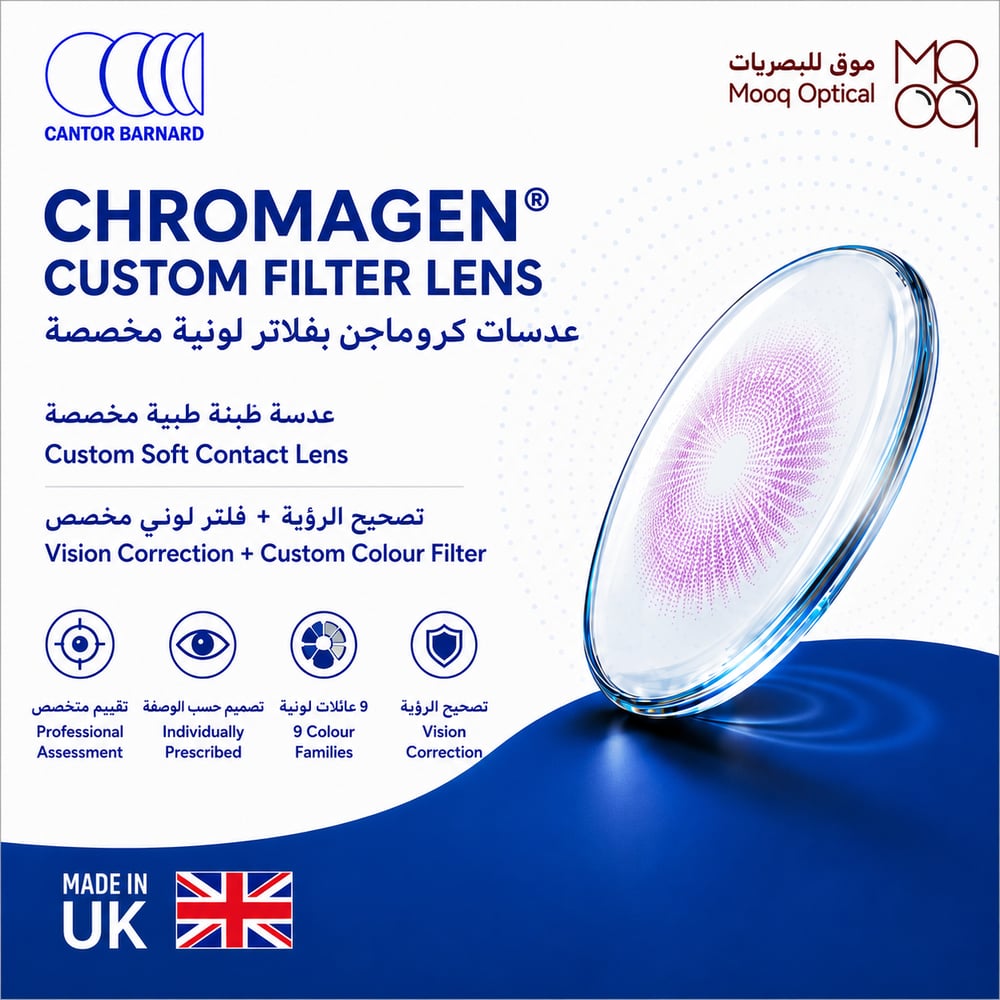
ChromaGen contact lenses are a system of customized soft contact lenses that use different colored filters, with the option to manufacture each lens according to the patient’s prescription to correct Myopia, Hyperopia, or Astigmatism.
The system is available in a range of colors and filter densities. The most suitable filter for each person is selected using the:
ChromaGen Fitting / Assessment System
before the final lens is ordered.
Cantor Barnard states that a dedicated fitting and assessment set is required to carry out the evaluation.
Delivery Time
The lenses are supplied within a maximum period of:
30 to 60 days
from the date the order is confirmed.
Lens Designs
The lens can be manufactured in:
Hydrolens
for spherical prescriptions.
For users requiring Toric correction for astigmatism, it can be manufactured in:
Hydrocyl
The system offers a very wide range of:
- Base Curves
- Diameters
- Sphere Powers
- Cylinder Powers
- Axis options
- Filter pupil diameters
Intended Use
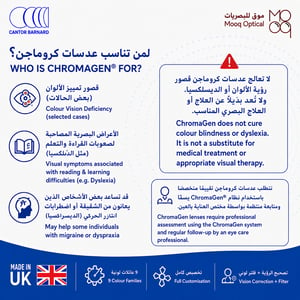
Cantor Barnard markets ChromaGen as a system that may help with some symptoms associated with:
- Colour Vision Deficiency
- Certain visual symptoms that may occur alongside academic or reading difficulties
However, Cantor Barnard clearly states that ChromaGen does not cure or treat Colour Vision Deficiency or Academic Skills Disorders.
Official Technical Specifications
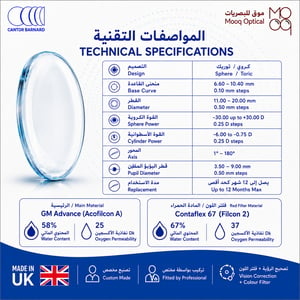
Specification | Value |
|---|
Lens Type | Custom Soft Filter Contact Lens |
Vision Type | Single Vision |
Designs | Sphere / Toric |
Design Families | Hydrolens / Hydrocyl |
Base Curve | 6.60–10.40 mm |
BC Steps | 0.10 mm |
Diameter | 11.00–20.00 mm |
Diameter Steps | 0.50 mm |
Sphere Power | -30.00D to +30.00D |
Sphere Steps | 0.25D |
Higher Powers | May be available |
Cylinder | -6.00 to -0.75 DC |
Cylinder Steps | 0.25 DC |
Axis | 1°–180° in the current booklet |
Pupil Diameter | 3.50–9.00 mm |
Pupil Steps | 0.50 mm |
Fitting System | Required |
Fitting | Eye Care Professional |
The current website lists Axis values starting from 5° in one section, while the official January 2026 booklet lists:
1°–180°
For product-store configuration, the newer booklet specification of 1°–180° may therefore be used, with confirmation from the laboratory when ordering.
Primary Lens Material
The current primary material is:
GM Advance – Acofilcon A
Property | Value |
|---|
Material | GM Advance |
USAN | Acofilcon A |
Water Content | 58% |
Material Dk | 25 |
Type | Soft Hydrogel |
Application | Most ChromaGen filters |
Red Filter Material
For the:
Red
filter, the current booklet specifies:
Contaflex 67 – Filcon 2
Property | Value |
|---|
Material | Contaflex |
Classification | Filcon 2 |
Water Content | 67% |
Material Dk | 37 |
Application | Red filter only |
Important Note About Dk
Material Dk: 25 – GM Advance
Material Dk: 37 – Contaflex 67, Red only
Final oxygen transmissibility varies depending on:
- Prescription
- Lens thickness
- Final manufactured lens design
ChromaGen Filter Colors
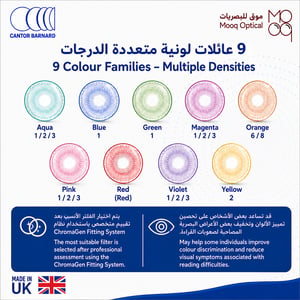
Cantor Barnard currently lists 9 color families, with several colors available in multiple filter densities.
Color | Densities |
|---|
Aqua | 1 / 2 / 3 |
Blue | 1 |
Green | 1 |
Magenta | 1 / 2 / 3 |
Orange | 6 / 8 |
Pink | 1 / 2 / 3 |
Red | Red |
Violet | 1 / 2 / 3 |
Yellow | 2 |
This results in:
19 currently published color / density combinations
across nine color families.
Colored Pupil Diameter
The filtered pupil area can be customized.
Pupil Diameter: 3.50–9.00 mm
in:
0.50 mm steps
This allows the filtered zone to be customized according to the visual assessment requirements of the individual user.
Is ChromaGen Single Vision or Multifocal?
For the:
ChromaGen Contact Lens
the lens is:
Single Vision
and is available in two primary forms.
Sphere
For correction of:
Toric
For correction of:
Astigmatism
with:
ChromaGen spectacle lenses may also be available as:
- Single Vision
- Bifocal
- Progressive
This applies to Spectacle Lenses, not to ChromaGen contact lenses.
Uses Listed by Cantor Barnard
The official booklet lists potential use of the system in relation to:
Condition | Use |
|---|
Myopia | Correction of nearsightedness |
Hyperopia | Correction of farsightedness |
Astigmatism | Astigmatism correction |
Colour Vision Deficiency | Assistance with some color discrimination tasks |
Co-occurring symptoms of Academic Skills Disorders | Assessment of some visual symptoms associated with reading or learning difficulties |
Important Scientific Note Regarding Dyslexia
Cantor Barnard uses statements relating to improvements in reading, writing, and comprehension.
However, the systematic review referenced in the supplied material, published in Ophthalmic & Physiological Optics, found that the quality of evidence supporting colored lenses and filters for improving reading was limited, and that studies with a lower risk of bias provided weaker support for benefit.
A professionally selected filter may help reduce certain visual symptoms in some users.
However:
ChromaGen should not be presented as a treatment for dyslexia or learning disorders.
This is also consistent with Cantor Barnard’s own statement that ChromaGen does not cure these conditions.
ChromaGen and Colour Vision Deficiency
Independent studies of the ChromaGen system have reported different outcomes that require careful interpretation.
According to the supplied material, a 2026 study involving 80 people with congenital Colour Vision Deficiency found that:
- Magenta filters reduced errors in several color tests
- Pink filters reduced errors in several color tests
- Violet filters reduced errors in several color tests
However, the effect was limited in people with:
Dichromacy
particularly:
Protanopia
and the system did not reduce the underlying severity of Colour Vision Deficiency itself.
Another study reported improvement in certain color-vision test results but also found reductions in:
- Best-corrected distance visual acuity
- Best-corrected near visual acuity
- Some contrast-sensitivity measurements
An older study also reported improvements in some color discrimination tasks while emphasizing that ChromaGen should not be used to bypass official occupational color-vision requirements.
Therefore:
ChromaGen filters may help some people with Colour Vision Deficiency distinguish certain colors or perform specific color-related tasks, but they do not restore normal color vision and do not cure Colour Vision Deficiency.
Fitting and Assessment System
Cantor Barnard states:
Fitting set required to carry out assessment.
This means that the user should not select:
- Pink
- Magenta
- Aqua
- Violet
- Or another filter color
based on personal preference or appearance alone.
A professional assessment must first determine:
- Filter color
- Filter density
- Which eye will use the filter
- Pupil diameter
- Vision prescription
The company also indicates that the assessment system may include up to:
25 different trial lenses
with variations in:
- Color
- Pupil size
- Other fitting parameters
Key Features
- Customized color-filtering system
- 9 color families
- Multiple filter densities
- Sphere or Toric designs
- Myopia correction
- Hyperopia correction
- Astigmatism correction up to -6.00D
- Sphere powers up to ±30.00D
- Wide Base Curve range
- Wide Diameter range
- Custom Pupil Diameter
- GM Advance 58% material
- Contaflex 67% material for the Red filter
- Individually manufactured according to each eye’s prescription
- Requires assessment using the ChromaGen Fitting System
- Available as contact lenses and as ChromaGen spectacle filters
Wearing Schedule
The eye care professional determines:
Wear Schedule
and:
Replacement Frequency
according to:
- Lens design
- Patient prescription
- Ocular response
- Fitting assessment
The lenses should not be worn while sleeping unless specifically permitted by the eye care professional.
Lens Care Instructions
According to Cantor Barnard instructions for reusable soft contact lenses:
Before Handling
- Wash your hands thoroughly
- Dry your hands completely before touching the lenses
After Removal
- Clean and rub the lens using an appropriate lens-care solution
- Rinse with contact lens solution
- Store in fresh disinfecting solution
- Do not reuse old solution
Avoid
- Tap water
- Saliva
- Swimming while wearing the lenses
- Showering while wearing the lenses
The contact lens case should also be replaced at least:
Once per month
When to Stop Wearing the Lens
Stop wearing the lens and contact an eye care professional if you experience:
- Eye pain
- Redness
- Swelling
- Blurred vision
- A white or yellow spot on the cornea
Important Warnings
ChromaGen is a customized color-filtering system. The filter color should not be selected based on appearance alone and must be determined through professional assessment.
The lens does not cure:
- Colour Vision Deficiency
- Dyslexia
- Learning disorders
Individual response may vary considerably.
Results achieved while wearing ChromaGen should not be used to bypass:
Occupational or regulatory color-vision requirements.
In some users, the filter may affect:
- Visual acuity
- Contrast sensitivity
Therefore, visual performance should be professionally assessed before the final lens is dispensed.



 McGuire lenses
Show more