Hydrolens Afocal Bandage – Cantor Barnard
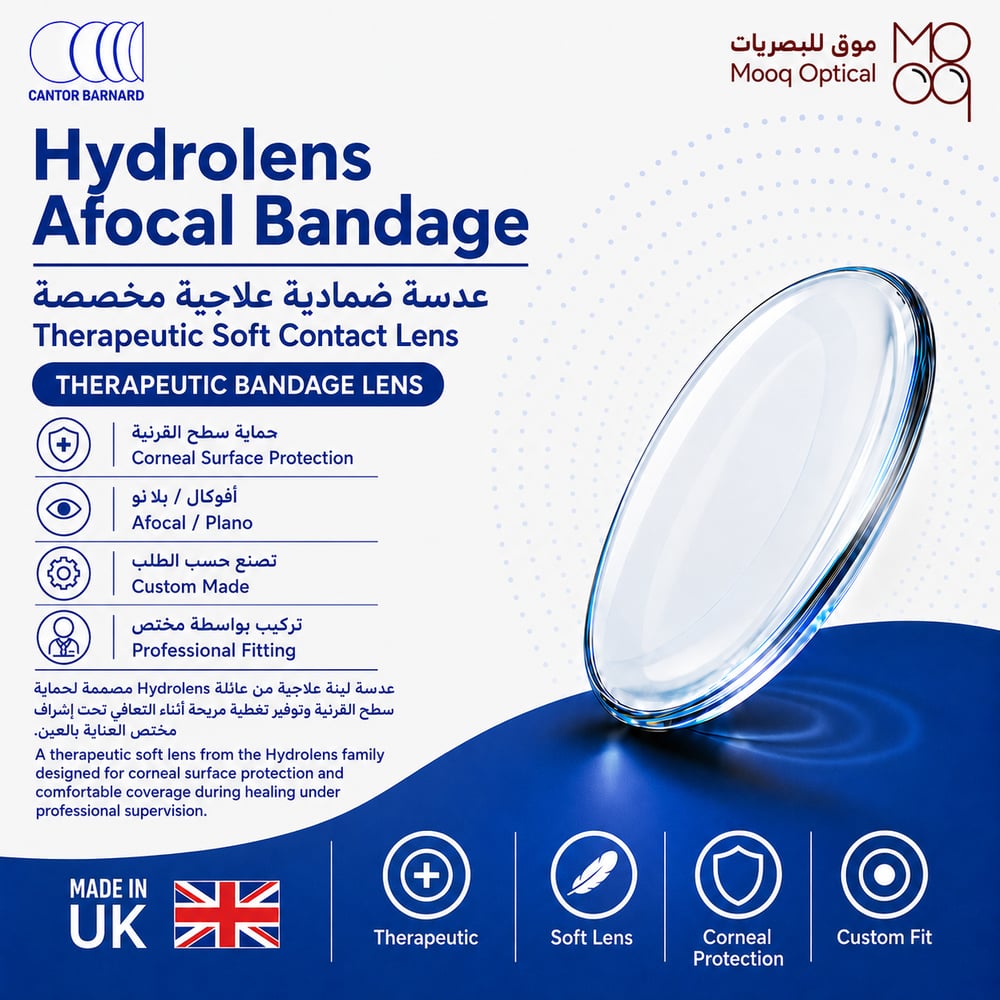
Hydrolens Afocal Bandage is a specialized therapeutic soft contact lens from the Cantor Barnard specialty lens range, designed to act as a protective layer over the corneal surface rather than primarily providing vision correction.
Bandage contact lenses help reduce direct friction between the eyelid and the corneal surface and may help protect the epithelium during healing, according to the assessment and treatment plan of an ophthalmologist or therapeutic contact lens specialist.
Professional sources associated with the product describe an:
Afocal / Plano
version with no primary corrective optical power.
Delivery Time
The lenses are supplied within a maximum period of:
30 to 60 days
from the date the order is confirmed.
Custom Clinical Fitting
The current Cantor Barnard fitting guide includes Bandage lenses within the Hydro family and outlines the basic principles for selecting:
- Diameter
- Base Curve
- Lens movement
- Centration
- Edge behavior
- Push-Up Test response
This confirms that these lenses require individualized clinical fitting and should not be treated as standard ready-made contact lenses.
Key Features
- Therapeutic Soft Contact Lens
- Designed to protect the corneal surface
- Afocal version is Plano
- Spherical design
- Large diameters may be ordered for broader coverage
- Customized Base Curve options
- Part of the Hydrolens family
- Can be manufactured with different specifications according to clinical requirements and laboratory capabilities
- Custom fitting based on HVID and K readings
- Clinical assessment of movement, centration, and coverage
- Used under professional eye care supervision
- Manufactured in the United Kingdom
Suitable Clinical Uses
Professional sources describing Hydrolens Afocal Bandage identify it as a lens intended to protect the cornea during healing or in certain chronic conditions.
In general clinical practice, bandage contact lenses may be used, according to the treating clinician’s diagnosis, in situations such as:
- Protection of the corneal surface during healing
- Certain corneal surface injuries and abrasions
- Recurrent Corneal Erosion
- Some persistent epithelial defects
- Protection following certain corneal procedures or surgeries
- Reduction of mechanical eyelid friction against a damaged corneal surface
This does not mean that the lens is automatically appropriate for every one of these conditions.
The indication, wearing duration, and any accompanying medications must be determined by the treating ophthalmologist.
Published Specialized Specifications
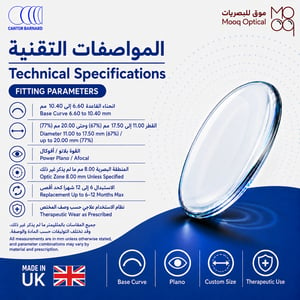
Specification | Hydrolens 67 Bandage | Hydrolens 77 Large Diameter |
|---|
Lens Type | Therapeutic Soft | Therapeutic Soft |
Power | Plano | Plano |
Base Curve | 6.60–10.40 mm | 6.60–10.40 mm |
BC Steps | 0.20 mm | 0.20 mm |
Diameter | 11.00–17.50 mm | 11.00–20.00 mm |
Diameter Steps | 0.50 mm | 0.50 mm |
Design | Spherical Bi-Curve | Spherical Bi-Curve |
Optic Zone | 8.00 mm unless specified | 8.00 mm unless specified |
Centre Thickness | Approx. 0.18 mm* | According to manufacture |
Colour | Clear | Clear |
Handling Tint | May be available | May be available |
Replacement | 6–12 months according to use | 6–12 months according to use |
*The published thickness refers to a reference configuration and is not a fixed thickness for every lens.
Important Note About Material and Dk
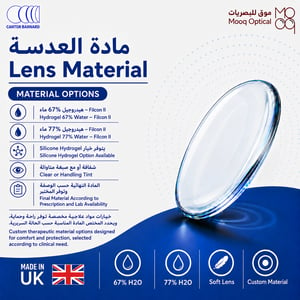
Material: Selected according to prescription, clinical requirements and laboratory availability.
The lens material should be selected according to:
- Medical condition
- Prescription
- Required lens design
- Laboratory manufacturing capabilities
Therefore, the general Hydrolens Afocal Bandage product should not be assigned one fixed material or oxygen permeability value unless the exact manufactured version is known.
Published Afocal Version
A UK professional database lists one specific Hydrolens Afocal Bandage configuration with the following specifications:
Property | Value |
|---|
Design | Hydrogel Spherical |
Front Surface | Spherical Bi-Curve |
Back Surface | Spherical Bi-Curve |
Base Curve | 8.40 / 8.80 mm |
Diameter | 15.50 mm |
Power | Approximately Plano |
Centre Thickness | 0.21 mm |
Material | Filcon II |
Water Content | 67% |
Colour | Clear |
Intended Use | Therapeutic / Bandage |
These specifications refer to a particular registered version and should not be interpreted as the specifications of every current Bandage lens.
For a general product listing, the broader customized Hydrolens parameter range is more appropriate.
Lens Design
Specialized sources describe the lens design as:
Spherical Bi-Curve Front Surface
and:
Spherical Bi-Curve Back Surface
meaning the lens uses spherical bi-curve geometry on both the front and back surfaces.
Optical Power
The primary therapeutic version is:
Plano / Afocal
This means its main purpose is not correction of myopia or hyperopia.
For a product page:
Power: Plano
Vision Correction: Not the primary purpose
Primary Function: Corneal Protection
Current Fitting Procedure
The current Cantor Barnard Hydro & Zero 6 Ranges fitting guide specifically includes Bandage lenses.
The fitting process begins with:
- Full eye examination
- Keratometry
- HVID measurement
- Diameter selection
- Base Curve selection
- On-eye lens assessment
Diameter Selection
As an initial fitting guideline, Cantor Barnard recommends:
Diameter = HVID + 2.00 to 3.00 mm
The diameter is then adjusted according to:
- Coverage
- Centration
- Movement
- Edge behavior
- Push-Up Test
Base Curve Selection
Base Curve selection is based on:
K readings
The fitting guide provides starting recommendations according to lens diameter and corneal shape.
For parameters outside standard fitting tables, the laboratory may be contacted for customized recommendations.
Settling Time
After lens insertion, allow approximately:
30 minutes
before carrying out the final fitting assessment.
The following should then be evaluated:
- Comfort
- Centration
- Limbal Coverage
- Edge behavior
- Movement with Blink
- Push-Up Test
Good Fit
A good fit according to the fitting guide is characterized by:
- Good comfort
- Good centration
- Complete limbal coverage
- Stable edge
- Appropriate movement
- Easy movement during Push-Up Test
- Good return to the central position
Steep Fit
A steep fit may show:
- Very little or no movement
- Difficulty performing the Push-Up Test
- Slow return to the centered position
- Conjunctival indentation
- Blanching
In these situations, the eye care professional should reassess:
Flat Fit
A flat fit may show:
- Poor centration
- Inadequate coverage
- Excessive movement
- Edge stand-off
- Fluting
- Excessively easy movement during the Push-Up Test
- Poor return to the central position
Wearing Schedule
Care is required when describing the wearing schedule.
It is not recommended to list the general product permanently as:
Daily Wear
or:
Extended Wear
because Hydrolens Bandage is a therapeutic lens.
In certain clinical situations, the treating physician may decide to leave the lens in place continuously under monitoring and with prescribed medication, while other cases may require a different wearing schedule.
The most appropriate product-page wording is:
Wear Schedule: As prescribed and monitored by the treating eye care professional.
Lens Care
If the lens is removed and reused according to the clinician’s instructions:
- Wash and dry hands thoroughly before handling
- Use a care system designed for reusable soft contact lenses
- Do not use tap water
- Do not use saliva
- Use fresh solution for every cleaning cycle
- Do not wear a damaged or torn lens
- Follow the treating clinician’s instructions regarding eye drops used with the lens
If the physician prescribes the lens as a continuously worn therapeutic bandage, the patient should not remove, clean, or reinsert the lens independently.
The prescribed medical plan should be followed exactly.
Important Warning
Hydrolens Afocal Bandage is a specialized therapeutic medical contact lens and is not intended for self-directed use.
It should be:
- Prescribed
- Fitted
- Monitored
by an ophthalmologist or other appropriately qualified eye care professional.




 العدسات الضمادية والاصطناعية
Show more