Nissel KII Soft – Cantor Barnard
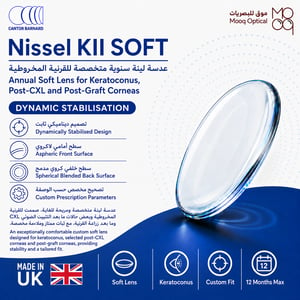
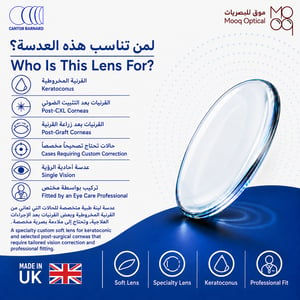
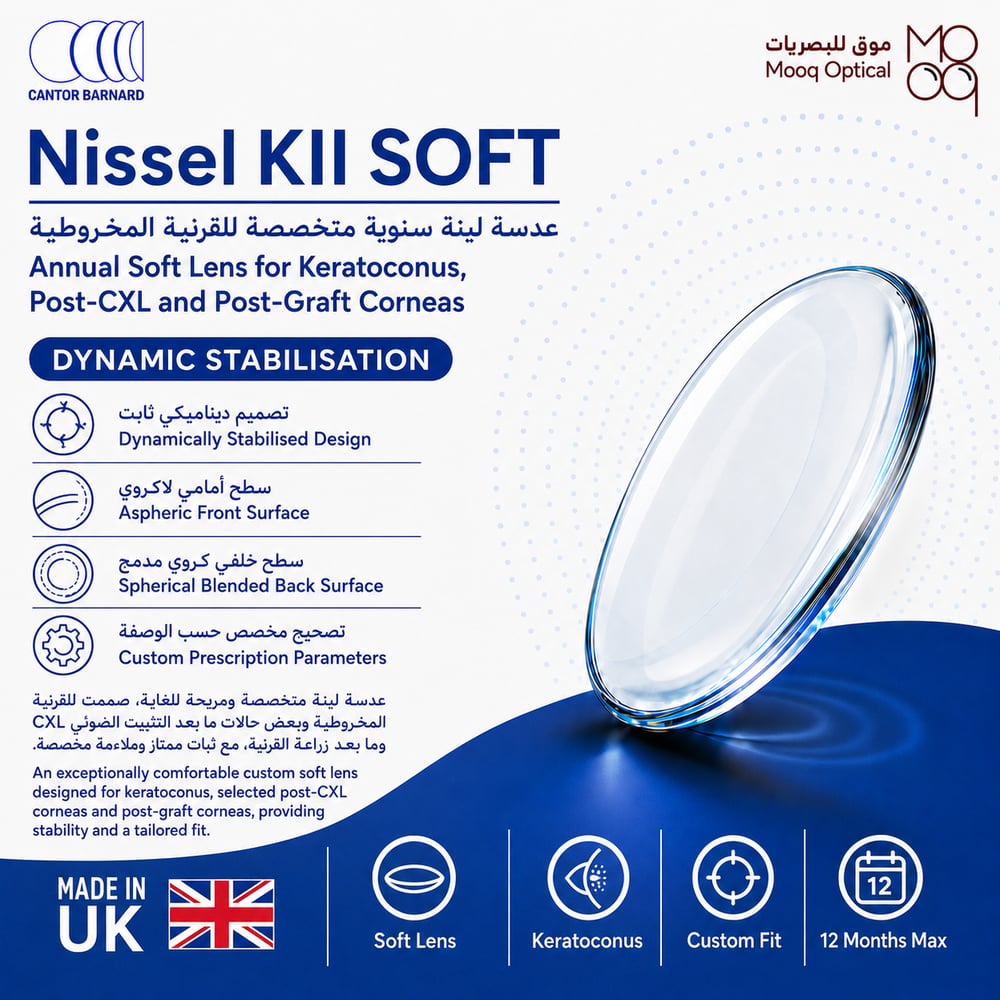
Nissel KII Soft by Cantor Barnard is a specialized soft medical contact lens designed to manage refractive errors caused by Keratoconus.
It provides a customized soft-lens option for corneas that require greater optical stability and more individualized fitting than standard soft contact lenses.
Delivery Time
The lenses are supplied within a maximum period of:
30 to 60 days
from the date the order is confirmed.
Optical Design
Nissel KII Soft features:
Aspheric Front Surface
with:
Dynamic Stabilisation
and a:
Spherical Blended Back Surface
The dynamic stabilization system helps maintain lens orientation, which is particularly important when the prescription includes:
for correcting astigmatism associated with keratoconus.
Cantor Barnard also lists the lens for professional fitting in selected:
- Post-CXL Corneas
- Post-Graft Corneas
However, suitability in these cases should be determined from corneal topography and professional assessment rather than diagnosis alone.
Product Classification
Specification | Value |
|---|
Product | Nissel KII Soft |
Lens Type | Custom Soft Contact Lens |
Primary Application | Keratoconus |
Additional Applications | Post-CXL / Post-Graft Corneas |
Vision Type | Single Vision |
Toric Correction | Available |
Design | Aspheric + Dynamically Stabilised |
Front Surface | Aspheric |
Back Surface | Spherical Blended |
Material | GM Advance |
Material Name | Acofilcon A |
Water Content | 58% |
Dk | 25 |
Manufacturer | Cantor Barnard |
Made In | United Kingdom |
Is It Single Vision or Multifocal?
Nissel KII Soft is:
Single Vision
and is not:
Multifocal
However, it can be manufactured with:
Sphere + Cylinder + Axis
and can therefore provide Toric correction for astigmatism associated with keratoconus.
The presence of Cylinder and Axis does not make the lens multifocal.
Cantor Barnard offers separate products for presbyopia and multifocal correction, such as the PV Series.
Lens Design
Nissel KII Soft is a specialized soft lens with:
- Aspheric front optics
- Dynamic stabilization
- Spherical blended back surface
The design is intended to provide improved orientation stability and customized optical correction in keratoconus.
Official Specifications
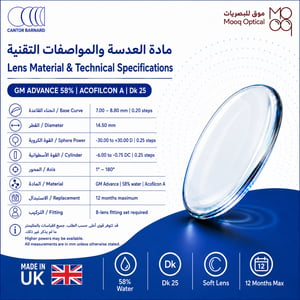
Specification | Value |
|---|
Base Curve | 7.00–8.80 mm |
BC Steps | 0.20 mm |
Diameter | 14.50 mm |
Sphere Power | -30.00D to +30.00D |
Sphere Steps | 0.25D |
Higher Powers | May be available on request |
Cylinder | -6.00 to -0.75 DC |
Cylinder Steps | 0.25 DC |
Axis | 1°–180° |
Material | GM Advance |
Water Content | 58% |
Material Name | Acofilcon A |
Dk | 25 |
Maximum Modality | 12 Months |
These parameter ranges are listed in the current Cantor Barnard product information and booklet.
Lens Material
The currently published lens material is:
GM Advance 58%
USAN:
Acofilcon A
Water content:
58%
Oxygen permeability:
Dk 25
GM Advance 58% Specifications
Property | Value |
|---|
Material | GM Advance |
USAN | Acofilcon A |
Water Content | 58% |
Oxygen Permeability ISO | Dk 25 |
Refractive Index – Hydrated | 1.40 |
Refractive Index – Dry | 1.52 |
Swell Factor | 1.36 |
Elastic Modulus | 0.28 MPa |
Tensile Strength | 0.35 MPa |
Elongation at Break | 253% |
ANSI Classification | Acofilcon A II 2 |
ISO Classification | Acofilcon A 2 (25) [58%] |
Contamac describes GM Advance as a soft GMA material with good water retention, on-eye stability, and durability.
UV Note
The GM Advance material specification indicates that a UV blocker may be available in the raw material.
However, this does not automatically mean that every finished Nissel KII Soft lens contains a UV blocker.
Therefore:
UV Protection should not be added to the product page unless confirmed by Cantor Barnard for the specific ordered lens.
Key Features
- Specialized soft lens for Keratoconus
- Suitable for selected Post-CXL cases
- Suitable for selected Post-Graft corneas following professional assessment
- Aspheric Front Surface
- Dynamic Stabilisation
- Spherical Blended Back Surface
- Sphere correction up to ±30.00D
- Higher powers may be available on request
- Cylinder correction up to -6.00D
- Full Axis range from 1°–180°
- GM Advance material
- 58% water content
- Dk 25
- Standard diameter 14.50 mm
- Multiple Base Curve options
- Specialized diagnostic fitting set
- Custom-made to prescription
- Maximum replacement modality up to 12 months according to professional assessment
Suitable Applications
The primary official indication is:
Refractive Errors Caused by Keratoconus
The product information also describes the design for:
- Keratoconic Corneas
- Post-CXL Corneas
- Post-Graft Corneas
From an optical perspective, the prescription may include:
- Associated Myopia
- Associated Hyperopia
- Astigmatism
- Irregular astigmatism caused by keratoconus, to the extent that it can be corrected with this specialized soft lens design
Important: The lens should not be described as treating keratoconus or stopping its progression.
Its primary purpose is:
Vision correction and specialized lens fitting.
Diagnostic Fitting Set
Cantor Barnard states that use of the:
Nissel KII Soft Fitting Set
is required during fitting.
The set contains:
8 Trial Lenses
with:
- Material: GMA
- Diameter: 14.50 mm
- Base Curve Range: 8.00–8.60 mm
Trial Lens Guide
K Reading | Trial BOZR | Trial Powers |
|---|
Less than 6.00 mm | 8.00 mm | -14.00 / -12.00D |
6.00–6.50 mm | 8.20 mm | -10.00 / -8.00D |
6.50–6.80 mm | 8.40 mm | -6.00 / -4.00D |
6.80–7.20 mm | 8.60 mm | -2.00 / Plano |
The full fitting set therefore contains:
8 lenses
Selecting the Trial Lens
Cantor Barnard recommends first performing:
- Full Refraction
- Complete eye examination
- Keratometry
- Corneal Topography
- Assessment of the corneal profile from the side when required
In mild cases with a relatively central cone, K readings may assist with initial lens selection.
In highly irregular corneas, keratometry may be less useful because of large variations in readings, and greater emphasis may be placed on:
- Corneal topography
- Clinical corneal shape
- On-eye fitting behavior
Initial Settling Time
After insertion of the trial lens:
Allow 5–10 minutes
before the initial fitting assessment.
Then evaluate:
- Fit
- Centration
- Movement
- Toric orientation marks
- Initial Over-Refraction
Good Fit
Cantor Barnard describes a good fit as:
- Comfortable
- Centrally positioned
- Small insertion bubbles disappear within approximately 2–3 minutes
- Vertical movement of approximately 1.00 mm after blinking
- Good recovery during the Push-Up Test
- Orientation marks in the correct vertical position
Flat Fit
Signs of a lens that is too flat may include:
- Poor centration
- Discomfort
- Excessive movement with blinking, greater than approximately 1.00 mm
- Significant lens drop when looking upward
In this situation, the fitting guide suggests trying a:
Steeper Base Curve
when available.
Steep Fit
Signs of an excessively steep fit may include:
- Movement of less than approximately 0.50 mm with blinking
- Large bubbles beneath the lens
- Lens rotation
- Noticeable resistance during the Push-Up Test
In this situation, the guide suggests trying a:
Flatter Base Curve
when available.
Stabilization Adjustment
If the lens is unstable, Cantor Barnard recommends considering:
- Increasing the overall diameter
- Using a steeper radius
depending on the professional assessment and fitting pattern.
Final Power Assessment
After achieving a:
Good Fit
allow the lens to settle for an additional:
20–25 minutes
Then perform:
Over-Refraction
to determine the final:
The orientation of the Toric marks and the amount and direction of lens rotation should also be evaluated.
Toric Orientation Marks
The Toric marks are located in the lower portion of the lens:
15° apart
The central line should be positioned:
At 6 o’clock
These marks allow the eye care professional to assess lens rotation and make the appropriate Axis compensation when ordering.
If No Cylinder Is Required
An important point in the Cantor Barnard fitting guide is that even if the patient does not require Cylinder correction, Cantor Barnard recommends ordering:
Plano Cylinder
to maintain the:
Stabilised Lens Design
This confirms that stabilization is an integral part of the Nissel KII Soft design and not only an optional feature for Toric prescriptions.
Information Required When Ordering
After identifying the optimal trial lens, Cantor Barnard recommends providing:
- Base Curve of the ideal trial lens
- Trial lens power
- Over-Refraction result
- Orientation Mark direction
- Amount of lens rotation
- Back Vertex Distance – BVD for the Over-Refraction
Recommended Order Form Fields
Field | English |
|---|
Eye | OD / OS |
Base Curve | BOZR / BC |
Diameter | Diameter |
Sphere | SPH |
Cylinder | CYL |
Axis | Axis |
K Readings | Keratometry |
Topography | Corneal Topography |
Over-Refraction | Over-Rx |
Lens Rotation | Rotation |
Orientation Mark | Orientation |
BVD | Back Vertex Distance |
Corneal Condition | Keratoconus / Post-CXL / Post-Graft |
Replacement Schedule
Cantor Barnard classifies Nissel KII Soft as an:
Annual Soft Lens
with a:
12 Months Maximum
replacement modality.
Recommended wording:
Replacement: Up to 12 months maximum, or according to the recommendation of the eye care professional.
Lens Care
The Nissel KII Soft guide specifically states that the lens may be cared for using:
- Hydrogen Peroxide Systems
- Multipurpose Systems
Cantor Barnard general instructions for reusable soft lenses recommend:
- Wash and dry hands thoroughly before handling the lens
- Rub the lens with contact lens solution after removal
- Rinse with the appropriate solution
- Store in fresh disinfecting solution
- Do not reuse old solution
- Do not use tap water
- Do not use saliva
- Follow the care system recommended by the eye care professional
- Clean the lens case according to instructions without tap water
- Replace the contact lens case at least once per month
What Should Be Avoided?
Do not:
- Sleep in the lenses unless specifically permitted by the eye care professional
- Swim while wearing the lenses
- Shower or use a hot tub while wearing the lenses
- Put water or saliva on the lenses
- Share the lenses with another person
- Continue wearing a damaged lens
- Continue wearing the lens if vision becomes blurred or the eye becomes red or painful
Important Warnings
Nissel KII Soft is a specialized medical soft contact lens for keratoconus and must be fitted and specified by an eye care professional using the dedicated Nissel KII Soft fitting set.
It may be suitable for selected Post-CXL and Post-Graft corneas after professional evaluation of corneal shape and topography.
The lens does not treat keratoconus and does not stop its progression.
Its purpose is to provide:
Customized visual correction and specialized contact lens fitting.
Stop using the lens and consult an eye care professional immediately if you experience:
- Pain
- Redness
- Swelling
- Unusual changes in vision




 McGuire lenses
Show more