Nissel Sixteen-50 – Cantor Barnard
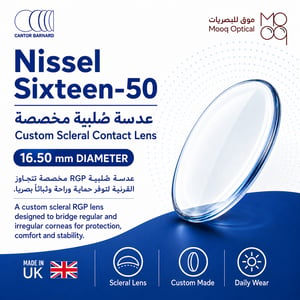
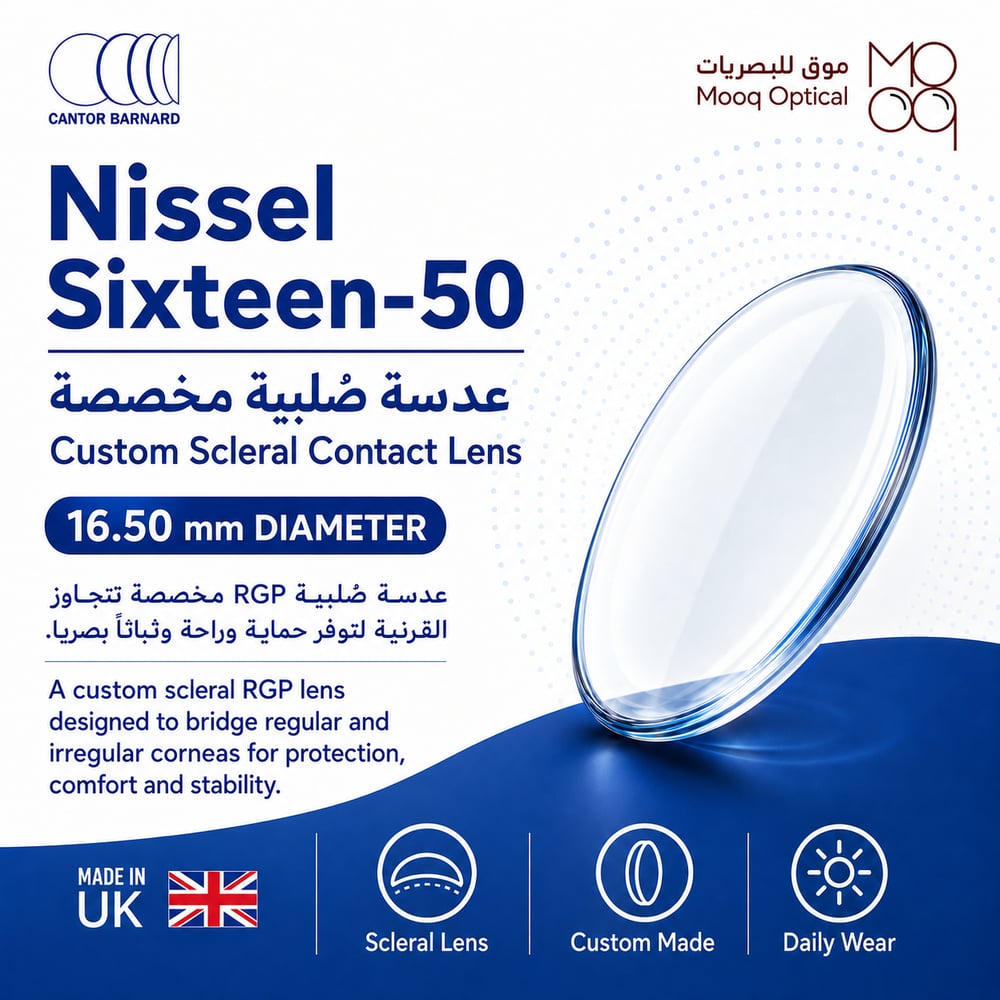
Nissel Sixteen-50 by Cantor Barnard is a rigid gas permeable RGP scleral contact lens with a diameter of 16.50 mm, designed to create a vault over the cornea rather than resting directly on it, with the lens landing on the sclera.
This design creates a:
Tear Reservoir
between the lens and the cornea. This fluid reservoir helps maintain ocular surface hydration and may provide additional comfort during wear, while also supporting improved optical correction and stability in selected regular and irregular corneas.
Delivery Time
The lenses are supplied within a maximum period of:
30 to 60 days
from the date the order is confirmed.
Sagittal Depth-Based Fitting
The fitting process is based on:
Sagittal Depth – SAG
rather than Base Curve alone.
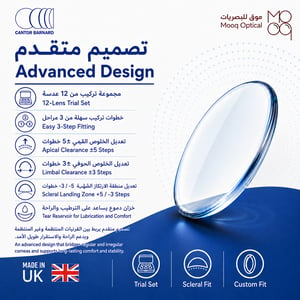
Cantor Barnard provides a diagnostic fitting set containing:
12 trial lenses
ranging from:
SAG 3.35 mm to 4.70 mm
allowing the eye care professional to select the most appropriate sagittal depth for the individual eye.
Independently Adjustable Zones
Three main areas can be adjusted independently:
- Apical Clearance
- Limbal Clearance
- Scleral Landing Zone
This allows the lens to be customized according to the shape and fitting requirements of each eye.
Key Features
- Large-diameter 16.50 mm scleral lens
- Custom-made for each eye
- Vaults over the cornea rather than resting directly on it
- Creates a tear reservoir that supports hydration
- Provides good optical stability
- Suitable for selected regular and irregular corneas
- 12-lens diagnostic fitting set
- Wide Sagittal Depth range
- Independently adjustable Apical Clearance
- Independently adjustable Limbal Clearance
- Independently adjustable Scleral Landing Zone
- High oxygen-permeability RGP materials
- Daily Wear
- Manufactured in the United Kingdom
- Professionally fitted and monitored
Suitable Applications
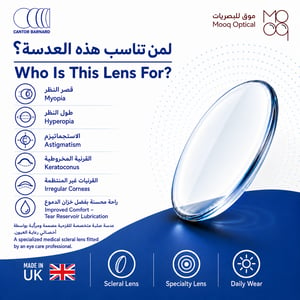
Cantor Barnard states that Nissel Sixteen-50 may help with the correction or management of:
- Myopia
- Hyperopia
- Astigmatism
- Keratoconus
- Irregular corneas
- Cases that may benefit from a Tear Reservoir for improved comfort and hydration
The presence of one of these conditions does not automatically mean that the lens is suitable.
A full examination, corneal assessment, topography, and diagnostic fitting should be carried out by an eye care professional.
Technical Specifications
Specification | Sixteen-50 |
|---|
Lens Type | Custom Scleral RGP |
Diameter | 16.50 mm |
Power Range | -30.00D to +30.00D |
Power Steps | 0.25D |
Higher Powers | May be available on request |
Wear | Daily Wear |
Replacement | Up to 12 months |
Trial Set | 12 lenses |
Trial Power | Plano |
Minimum SAG in Set | 3.35 mm |
Maximum SAG in Set | 4.70 mm |
Country | United Kingdom |
Available Materials
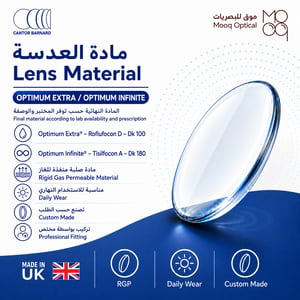
Optimum Extra
- Material: Optimum Extra
- USAN: Roflufocon D
- Dk: 100
- Cantor Barnard Color: Clear
Cantor Barnard lists Optimum Extra as a primary material for this lens.
It is described as a high oxygen-permeability material suitable for scleral, keratoconus, and other GP lens designs.
Optimum Infinite
- Material: Optimum Infinite
- USAN: Tisilfocon A
- Dk: 180
- Colors: Blue / Clear
Optimum Infinite is a Hyper-Dk material developed specifically to meet the demands of designs such as scleral lenses.
It offers:
- Dk 180
- Hyper oxygen permeability
- Good flexural resistance
- Good scratch resistance
- High wettability
Material Comparison
Property | Optimum Extra | Optimum Infinite |
|---|
Dk | 100 | 180 |
Oxygen Permeability | High | Hyper |
Material | Roflufocon D | Tisilfocon A |
Cantor Tint | Clear | Blue / Clear |
Scleral Suitable | Yes | Yes |
Diagnostic Fitting Set
The Sixteen-50 fitting set contains:
12 Plano trial lenses
Code | SAG | K Reading |
|---|
F3 | 3.35 mm | 8.60 |
F2 | 3.45 mm | 8.35 |
F1 | 3.55 mm | 8.10 |
A | 3.65 mm | 7.85 |
S1 | 3.80 mm | 7.60 |
S2 | 3.95 mm | 7.35 |
S3 | 4.10 mm | 7.10 |
K1 | 4.20 mm | 6.85 |
K2 | 4.30 mm | 6.60 |
K3 | 4.40 mm | 6.35 |
K4 | 4.55 mm | 6.10 |
K5 | 4.70 mm | 5.85 |
Lower-SAG lenses are generally intended as starting points for eyes with normal or moderate sagittal depth, while the higher-SAG K lenses may assist in fitting keratoconus and eyes with greater sagittal depth.
Fitting Procedure
Before fitting, Cantor Barnard recommends:
- Full Refraction
- Complete eye examination
- Keratometry
- Corneal Topography where possible
- Selection of the trial lens according to ocular shape and K readings
- Assessment of the appropriate SAG
Lens Application During Fitting
The lens should be completely filled with:
Non-Preserved Saline + Fluorescein
Cantor Barnard specifically states that:
Aerosol Saline
should not be used for this purpose.
The lens is inserted while keeping the patient’s head approximately parallel to the floor to help prevent air bubbles from becoming trapped beneath the lens.
Ideal Fit
Cantor Barnard evaluates several key fitting areas.
Apical Clearance
The ideal fitting pattern should show:
- No corneal touch
- No trapped bubbles
- A Tear Reservoir of approximately 300 microns
The trial lens itself has a thickness of approximately:
300 microns
and may be used as a visual reference when evaluating clearance.
Limbal Zone
The lens should vault completely over the limbal area with:
- Appropriate clearance
- Even fluorescein pattern
- No touch
Scleral Zone
A uniform fluorescein band should be visible beneath the scleral landing zone.
There should be no:
- Blanching
- Impingement
- Hyperaemia
Settling Period
After achieving an acceptable initial fit:
Leave the lens on the eye for approximately 60 minutes.
After this settling period:
- Reassess the fit
- Recheck clearance
- Reassess the scleral landing zone
- Perform Over-Refraction to determine final lens power
Available Adjustments
A major feature of the design is that the three principal zones can be adjusted independently.
Apical Clearance
- Increase: up to +5 steps
- Decrease: up to -5 steps
Each step:
50 microns
Approximate total adjustment range:
±250 microns
Limbal Clearance
- Increase: +3 steps
- Decrease: -3 steps
Each step:
50 microns
Approximate total adjustment range:
±150 microns
Scleral Landing Zone
- Increase: up to +5 steps
- Decrease: up to -3 steps
Each step:
50 microns
Moving from Sixteen-50 to Eighteen-20
Cantor Barnard states that if the eye care professional needs to change the diameter from:
16.50 mm
to:
18.20 mm
the other parameters do not necessarily need to be altered automatically.
The system is designed so that the fitter may transition between the two diameters while maintaining other specifications when clinically appropriate.
Lens Removal
The lens may be removed:
- Using the eyelids
- Using a Plunger
When using a plunger, it should be placed on the:
Edge of the lens
rather than the center.
The lens should then be removed using a gentle twisting motion.
Lens Care Instructions
- Wash and dry hands thoroughly before handling the lens
- Use care products specifically designed for RGP lenses
- Clean, rub, rinse, and disinfect according to the recommended care system
- Use chemical disinfection only
- Do not use an Autoclave
- Do not use tap water on the lens or lens case
- Avoid swimming while wearing the lenses
- Avoid showering while wearing the lenses
- Use fresh solution during every cleaning cycle
- Replace the lens case approximately every 1–2 months
- If the lens has not been used for 28 days, fully disinfect it again and use a new lens case
Exposure of the lens or lens case to non-sterile water significantly increases the risk of microbial contamination and infection.
Filling the Lens Before Insertion
Before placing the lens on the eye, fill the lens bowl using:
Preservative-Free / Non-Preserved Saline
Do not use RGP cleaning solution to fill the lens before insertion.
Wearing and Replacement Schedule
The lens is designed for:
Daily Wear
with a maximum replacement period of:
Up to 12 months
The eye care professional may recommend earlier replacement depending on:
- Lens condition
- Deposits
- Changes in fitting parameters
- Lens surface integrity
- Ocular requirements
Cantor Barnard’s general RGP instructions also state that the total specified lifespan of RGP lenses is:
Two years including storage and use
while actual wear after starting use should not exceed:
One year
Important Warnings
Nissel Sixteen-50 is a specialized custom scleral medical contact lens manufactured according to the measurements and prescription of each eye. It must be prescribed, fitted, and monitored by an appropriately qualified eye care professional.
The lens is intended for:
Daily Wear only
and its parameters or wearing schedule should not be changed without professional review.
Do not expose the lens or lens case to:
- Tap water
- Swimming pool water
- Shower water
Stop wearing the lens immediately and consult an eye care professional if you experience:
- Eye pain
- Persistent redness
- Light sensitivity
- Discharge
- Sudden changes in vision




 McGuire lenses
Show more