Soper Cone RGP – Keratoconus
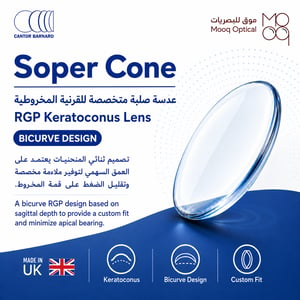
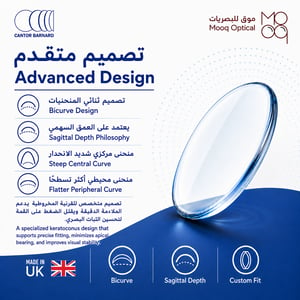
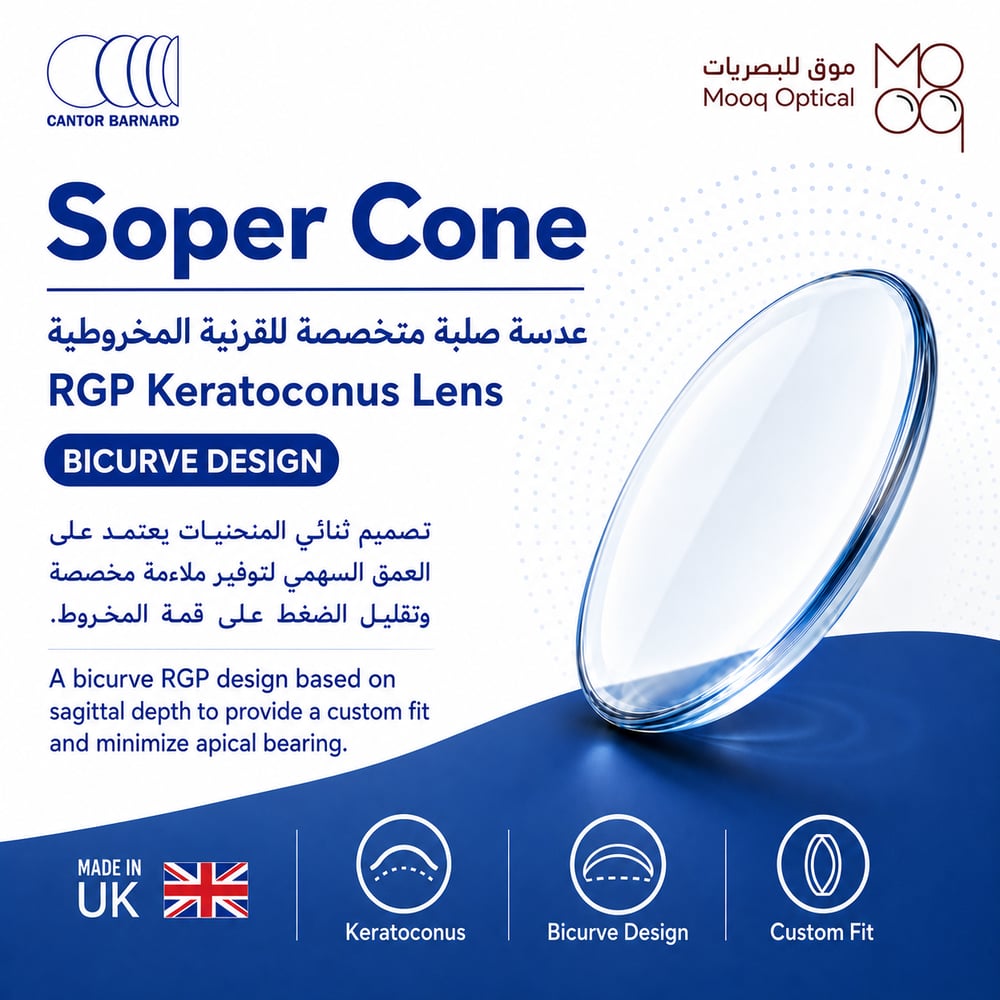
Soper Cone RGP is a specialized contact lens design for Keratoconus, based on a bi-curve system consisting of a steep central curve corresponding to the cone area and a flatter peripheral curve corresponding to the relatively more regular peripheral cornea.
Delivery Time
The lenses are supplied within a maximum period of:
30 to 60 days
from the date the order is confirmed.
Sagittal Depth-Based Design
The Soper fitting philosophy is based on:
Sagittal Depth
The depth of the lens over the cornea is controlled through the relationship between:
- Central Base Curve
- Central Optic Zone Diameter
The vault increases as the central curve becomes steeper relative to the selected diameter.
The traditional fitting objective is to achieve a relationship that minimizes excessive:
Apical Bearing
which may contribute to corneal irritation or scarring over time.
The original Soper design was developed using PMMA, but professional references indicate that it may also be manufactured using modern:
GP / RGP Materials
Modern specialty lens catalogs also continue to list Soper Cone as an option for irregular corneas.
Key Features
- Specialized design for Keratoconus
- Bicurve Design
- Based on Sagittal Depth
- Steep central zone
- Flatter secondary curve for the peripheral cornea
- Sagittal depth can be modified according to cone shape and severity
- Designed to reduce excessive Apical Bearing
- Three diagnostic groups for different stages of Keratoconus
- Custom-made according to measurements and prescription
- May be manufactured in different RGP materials depending on laboratory capabilities
- Suitable for fluorescein-based fitting assessment
- Historically established specialized Keratoconus design
Technical Design
The Soper Cone design is primarily composed of two main curves.
1. Central Base Curve
A relatively steep central curve designed to provide:
Vault over the cone
2. Secondary / Peripheral Curve
A flatter curve designed to transition toward the relatively more regular peripheral cornea.
Classical references describe a traditional peripheral curve of approximately:
45.00 D / 7.50 mm
with variations in certain systems when very steep central curves are used.
These values are historical design references and should not be treated as confirmed current ordering specifications from Cantor Barnard.
Diagnostic Fitting System
The traditional Soper system consists of:
10 diagnostic lenses – A to J
divided into three groups according to the stage of Keratoconus.
Stage | Lenses | K Readings | Approx. Diameter | Optic Zone |
|---|
Mild | A–D | Less than 48.00 D | 7.4–7.5 mm | 6.0 mm |
Moderate | E–G | 48.00–54.00 D | 8.5 mm | 7.0 mm |
Advanced | H–J | More than 54.00 D | 9.5 mm | 8.0 mm |
Some UK references list the mild-group diameter as:
7.40 mm
while other references list:
7.50 mm
Therefore, the 0.10 mm difference should not be presented as a customer-selectable manufacturing option without the actual laboratory specification sheet.
Fitting Groups
Mild Keratoconus
Generally intended for early cases with:
K Readings below approximately 48 D
and typically uses:
- Smaller optic zones
- Smaller overall diameters
Moderate Keratoconus
Generally used for intermediate cases with:
K Readings approximately 48–54 D
Advanced Keratoconus
Generally used when:
K Readings exceed approximately 54 D
with larger diameter and optic zone systems in the traditional Soper design.
Fitting Procedure
The initial trial lens is selected according to:
- Keratometry
- Corneal Topography
- Cone location
- Cone size
- Severity of Keratoconus
- Sagittal Depth assessment
- Fluorescein pattern
- Lens centration
- Lens movement
The Base Curve or Sag is then adjusted gradually to reduce excessive apical contact and achieve an appropriate relationship between the lens and the cone.
Traditional Soper fitting references describe achieving a pattern where strong apical bearing is eliminated or only minimal apical clearance remains, according to the fitting philosophy being followed.
Selecting Lens Diameter
The traditional system relates lens diameter to cone size and severity.
In general:
Small or central cone → Smaller diameter
Larger or more advanced cone → Larger diameter
One professional reference describes smaller central cones beginning around:
7.5–8.8 mm
while decentered cones may require larger diameters of approximately:
8.8–9.5 mm
These are fitting guidelines rather than confirmed manufacturing limits from Cantor Barnard.
Lens Material
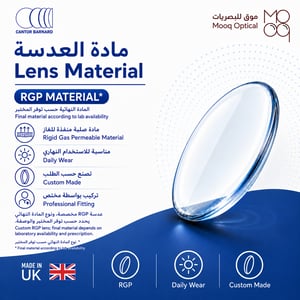
Material: RGP material selected according to prescription and laboratory availability.
Power Range
Power Range: Custom / According to prescription and manufacturing capabilities.
Base Curve
Base Curve: Custom – determined by the eye care professional.
Suitable Applications
The primary application is:
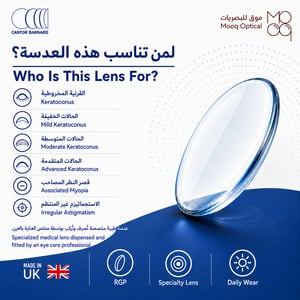
Keratoconus
including selected:
- Mild cases
- Moderate cases
- Advanced cases
- Central cones
- Cases that can be managed with a corneal Bicurve RGP design
The lens may also be used to correct:
- Associated Myopia
- Irregular Astigmatism associated with Keratoconus
However, its primary purpose is:
Visual management of Keratoconus
Note About Oval Cones
Soper is a relatively older lens design.
Some references note that its basic bi-curve structure may not provide ideal peripheral clearance in certain:
- Large cones
- Oval cones
- Advanced decentered cones
This is one reason newer designs such as:
were developed with more flexible peripheral modifications.
Fluorescein Assessment
The eye care professional should evaluate:
- Apical Bearing
- Apical Clearance
- Mid-Peripheral Bearing
- Peripheral Clearance
- Lens Movement
- Centration
- Tear Exchange
- Over-Refraction
An inappropriate fit may result in:
- Excessive central pressure
- Insufficient peripheral clearance
- Reduced tear exchange beneath the lens
Parameters Required When Ordering
Field | English |
|---|
Eye | OD / OS |
Central Base Curve | Central Base Curve / BOZR |
Optic Zone Diameter | BOZD |
Overall Diameter | Total Diameter |
Peripheral Curve | Peripheral Curve |
Power | Back Vertex Power |
Lens Material | Lens Material |
Lens Color | Handling Tint |
K Readings | Keratometry |
Corneal Map | Corneal Topography |
Keratoconus Stage | Mild / Moderate / Advanced |
Fluorescein Pattern | Fluorescein Pattern |
Over-Refraction | Over-Refraction |
Historical sources commonly describe the essential Soper Cone ordering elements as:
- Central Curve
- Central Zone Diameter
- Peripheral Curve
- Overall Diameter
Wearing Schedule and Lens Life
If manufactured by Cantor Barnard as an RGP lens, the company’s general RGP instructions state:
- Daily Wear
- Wearing hours are determined by the eye care professional
- Replacement schedule is determined by the eye care professional
- Actual RGP lens wear should not exceed one year
- Total defined lens life, including storage and use, is two years
Lens Care Instructions
If the final lens is manufactured by Cantor Barnard:
- Wash and dry hands thoroughly before handling the lens
- Keep fingernails short and smooth
- Use products specifically designed for RGP lenses
- Clean and rub the lens using the appropriate solution
- Chemically disinfect the lens
- Do not use an Autoclave
- Do not use tap water
- Do not use saliva
- Store the lens in fresh appropriate solution
- Replace the lens case approximately every 1–2 months
- If the lens has not been used for 28 days, disinfect it again for the full recommended period and use a new lens case
- Do not wear the lens if it is warped, scratched, cracked, or cannot be adequately cleaned
Important Warnings
Soper Cone is a specialized medical contact lens for Keratoconus and should only be prescribed and fitted by an eye care professional.
Do not wear the lens while sleeping if it is classified as:
Daily Wear
Do not wear the lens while swimming or showering, and do not expose the lens or lens case to non-sterile water.
Stop lens wear immediately and consult an eye care professional if you experience:
- Eye pain
- Redness
- Discharge
- Light sensitivity
- Changes in vision
Cantor Barnard warns that exposure to non-sterile water and inappropriate lens care may increase the risk of microbial keratitis, including:
- Acanthamoeba Keratitis
- Corneal Ulcer
- Corneal Abrasion




 McGuire lenses
Show more